timelets: (Default)

Что же здесь происходит? Почему нужно избушку повернуть? Почему нельзя войти просто? Часто перед Иваном гладкая стена
— «без окон без дверей» — вход с противоположной стороны. «У этой избушки ни окон, ни дверей, — ничего нет» (17). Но отчего же не обойти избушки и не войта с той стороны? Очевидно, этого нельзя. Очевидно, избушка стоит на какой-то такой види- мой или невидимой грани, через которую Иван никак не может перешагнуть. Попасть на эту грань можно только через, сквозь избушку, и избушку нужно повернуть, «чтобы мне зайти и выйти»

-- В. Пропп. Исторические корни волшебной сказки.


I never thought about избушка as an interface, an airlock, between spaces. We could probably model it as a pushout.

Another interesting observation:
Слеп человек не сам по себе, а по отношению к чeму-нибудь. Под «слепотой» может быть вскрыто понятие некоторой обоюдности невидимости.

...
Герой все это знает, потому что он г е р о й . Геройство его и состоит в его магическом знании, в его силе.
Вся эта система испытания отражает древнейшие представления о том, что подобно тому, как магически можно вызвать дождь или заставить зверя идти на ловца, можно вынудить вход в иной мир. Дело вовсе не в «добродетели» и «чистоте», а в силе.
timelets: (Default)


In the Sirens adventure, Odysseus with some help from the gods solves the diagonal argument.
timelets: (Default)
“...posted a much higher rate of tickets per transaction compared with typical movies, meaning more people are seeing it in big groups, The Box Office Company said.

It’s unprecedented to see presales like this for an original comedy,” said Marine Suttle, the company’s chief product officer. “It’s performing like a superhero movie.”

https://www.wsj.com/articles/barbenheimer-poised-to-deliver-blowout-weekend-at-the-box-office-9feef168


An interesting FOM: tickets per transaction. (an intensive quantity in Lawvere).
timelets: (Default)
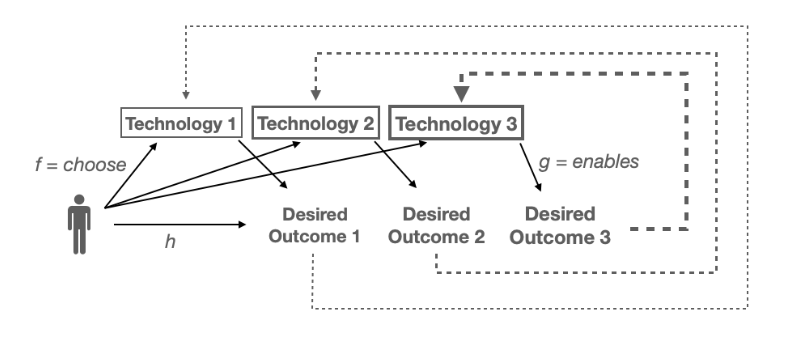
1 --> T1  --> T2
        \     /\
         \    |
          \   |
          _\| ]
             P


In the beginning...

e: 1 -> T1 is an equalizer
f: T1 -> T2
g: T1 -> P
h: P -> T2

f = h g

T1 is a narrative
T2 is an enablement
timelets: (Default)
Paraphrasing Kant, [Two things fill the mind with ever new and increasing admiration and awe, the more often and steadily we reflect upon them:] limits and co-limits."
timelets: (Default)
Smuggling in the Kan extension for dummies.


timelets: (Default)
When in doubt build a model based on the Kan extension. Or at least, use Lawvere's simplified version of it ( determination/choice).


* Questions (A) -> Little Red Riding Hood (B) -> Learning [Wolf Detection] (C)

A -> C maps to False ( A -> Ω), which hints at the idea that marginal knowledge can be modeled as a topos. We can also show the nature of the transition from Google Search to GPT.

* All objects are marginal.
timelets: (Default)
Под функцией понимается поступок действующего лица, определенный с точки зрения его значимости для хода действия.

I.Постоянными, устойчивыми элементами сказки служат функции действующих лиц, независимо от того, кем и как
они выполняются. Они образуют основные составные части сказки.
II. Число функций , известных волшебнойсказке, — о г р а н и ч е н о .
III.Последовательность функций всегда одинакова.
IV.Все волшебные сказки однотипны по своему строению.

-- Пропп, Морфология Сказки, 1928.
Read more... )

Most popular fairy tales have very little magic in them. They are way too short to use all the functions and their sequences identified by Propp.
In any case, where it does take place information sharing or advice involves providing a known solution to a known problem.
timelets: (Default)
Mythical heroes are singular and their number is finite. By contrast, the number of fairy tale heroes is infinite because they represent common people. Any little girl in the village is a Red Riding Hood. We just don't pick one of them as an example until the wolf attacks her. In the meantime, once Odysseus is always Odysseus.
timelets: (Default)
Пока ковырялся в своих примерах для книжки, обнаружил фундаментальную разницу между нарративами успеха в России и Америке.

В России: герой умер, но дело его живет. (нарратив мифа)
В Америке: герой жив, и дело его живет. (нарратив сказки)
timelets: (Default)
I think I'm getting the hang of the Kan extension concept. For example, the future, at least in technology, seems to be a left Kan extension, while the past and the present would be the right one. This is just an initial idea I and sill need to develop a proof with specific examples, using the system model.

In the meantime, I"m hoping to finish the first draft of the book by the end of this year. It looks quite doable because I'm already halfway through the Cinderella part, which should be next to last.
timelets: (Default)


https://www.youtube.com/watch?v=xTVSMJhDoOQ

Technology toolkit re-use is an extension problem. E.g. Julius Cesar's guide for building army camps using common agricultural approaches of the time. The use of steam engine manufacturing toolkit for railroads, steam ships, etc.

Technology choice or development is a lifting problem. E.g. discovery/choice of the right data set for a desired ML application (see IBM's recent failure vs TikTok's success).

In the LRRH narrative we see the failure of an existing solution to the extension problem, i.e. the werwolf destroys the girl's ability to deliver the medicine to her grandma.
timelets: (Default)


The image of a unit of "brick vs straw house" causality is life.
timelets: (Default)
“ ...to learn is to form an internal model of the external world.”

--- Stanislas Dehaene. “How We Learn.”


Note that he either externalizes confirmation of the model or considers its confirmation to be a part of formation. (upd. via trial and error).

cf: Lawvere's rough sketch of mathematical thinking where confirmation can be made explicit.

timelets: (Default)
This is an important insight: comma categories always have a terminal object. Now, I can relate it to Lawvere's interpretation of Hegel's logic.


"If X is any application of the graphic G , then the "comma" category G/X (whose objects are the elements of X and whose morphisms determine the action via the discrete fibration property of the labelling functor G/X -> G ) is again a graphic. Thus each particular application X of G provides one way G'-> G of expanding the graphic G into a more detailed graphic G' " -- Lawvere, Hegelian Taco.
timelets: (Default)
When we apply Hegel's (co-)concepts of determination and constitution to the Little Red Riding Hood narrative we can see that the best of LRRH is brought out (revealed) by the worst in Wolf. I also wonder how Heidegger's concept of technology as a revealer plays out in this context.
timelets: (Default)
By a graphic we will mean any finite category each of whose endomorphism monoids satisfies the identity xyx = xy ; in particular, a graphic monoid is a graphic category with one object.
By an application of a graphic category we will mean any right action of it on finite sets (i.e. any contravariant finite-set- valued functor on it).
-- Lawvere, The Hegelian "Taco", 1989.


I think social networking satisfies this requirement, e.g. Make Use Make = Make Use (a user to Make a new user).
timelets: (Default)
I've just realized that a typical market share chart is a representation of an exponential object.

User x Maker -> Share
timelets: (Default)
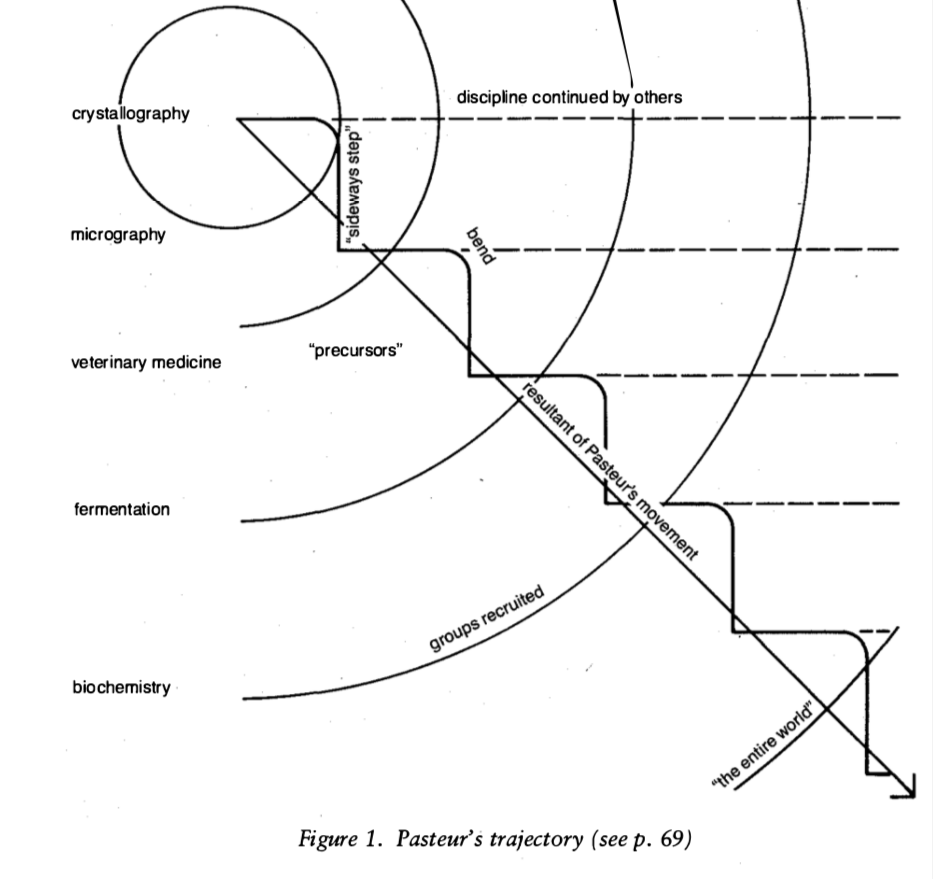
This is probably the best illustration of the concept of technoscience I've seen to-date.


--- Latour, TPoF, p. 267.
timelets: (Default)
Красная Шапочка — инструмент для понимания волка-оборотня.

upd. connect to Uber.

Profile

timelets: (Default)
timelets

December 2025

S M T W T F S
  12 3456
78910111213
14 151617 18 19 20
21 222324252627
28293031   

Syndicate

RSS Atom

Most Popular Tags

Style Credit

Expand Cut Tags

No cut tags
Page generated Dec. 24th, 2025 06:11 am
Powered by Dreamwidth Studios