timelets: (Default)
It's amazing to see how well the Japanese, esp. women, communicate without words. You always have to pay attention to it during negotiations. For example, here the Japanese prime minister Sanae Takaichi reacts to Trump's recent "Perl Harbor" comment. Watch the changing expression of her eyes, their movement, the turn of her head, the lips, the breathing pattern - all of it is classic Japanese theater without words. Can you read and interpret it?

https://x.com/AdamJSchwarz/status/2034668157718130718

If I'm not mistaken, there was a study during the pandemic that showed a difference in understanding of facial expressions between Western and Eastern people. In short, a mask on someone's face completely destroyed communications West–West, West-East, and East-West. By contrast, communications East-East were minimally affected because they were mostly through eye expressions, which is common in the culture.

Back to the Perl Harbor comment, what the MAGAsphere interpreted as a clever reply, the rest of the world perceived as a gaffe. Why? Because the question was about why Trump did not warn his allies about the impending attack on Iran, so that they could prepare for its consequences — oil shock, etc. Trump replied that "you" (Japan, who was a military adversary of the US in 1941) didn't warn "me" (the US) about Perl Harbor. It's a blunder on two levels:
1) The question is about a relationship between allies, while the answer is about a relationship between enemies. Instead of an meaningful answer, Trump produced a superficial brain fart. Obviously, warning one's allies about a pending military action is different from warning one's enemies.
2) Trump answer shows that he still thinks about Japan not as an ally, but as an enemy. Saying it in front of the Prime Minister of Japan is ugly and rude.

In any case, the episode was another Rorschach test that showed the gap between MAGA people and the rest of the world.
timelets: (Default)
at around 3:30, he says, I'm suspicious of philosophy.

timelets: (Default)
Federal Reserve Chair Jerome Powell plans to attend Wednesday’s Supreme Court hearing over the attempted dismissal of Fed Governor Lisa Cook by President Donald Trump, according to a person familiar with the situation.

Fed watchers and legal analysts say the outcome of the case will have a profound impact on the president’s ability to fire Fed governors and, by extension, on the central bank’s ability to set interest rates free of political interference.

https://www.bloomberg.com/news/articles/2026-01-19/fed-s-powell-plans-to-attend-cook-s-supreme-court-hearing

Powell wants to look the Supreme Court judges in the eyes and see if they have any courage left to practice law at all. Too bad tv cameras are not allowed during the hearings. It's going to be a moment reminiscent of the Godfather II Committee proceedings episode.


timelets: (Default)
“Books also had a “shelf life.” In a seventeenth-century bookseller’s shop, they could wait patiently for readers to come and purchase them. But staged plays were big events that happened at set times. They required an immense investment of both funds and labor: a paid company of actors and a theater, which must be built, purchased, or rented. They also needed to bring in the broadest cross-section of society if they were going to meet expenses. This difference in the technology and marketing of these two narrative media has only grown with time. ”

-- Abbott, H. Porter. “The Cambridge Introduction to Narrative (Cambridge Introductions to Literature).”


I wonder whether AI could close this gap.

p.s. a little bit later:
“...once revealed, the action of the story of the murder of Councilman Stubbs can be described in “terms of a linear chain: A->B->C->D (where D is the Death of Stubbs).
...
Characters are, usually, harder to understand than actions. They are themselves some of narrative’s most challenging gaps.
...
..we have to move from a horizontal to a vertical analysis, descending into the character to construct a plausible sense of her complexity.”

“The model, then, for the construct“tion of character in fictional narrative might look something like this:

reader/viewer + narrative -> reader/viewer’s construction of a character


In this view, a narrative can be represented by a product of Action and Character.
timelets: (Default)
When I took a movie/directors course, our professor told us how to know a good director from a bad one. Very simple, he said. If after the first 30-60 seconds of the movie you feel that you are in good hands, it means the director knows what he's doing. There's no science or method to it.

I haven't finished watching Emilia Perez yet, but I do feel that it's a piece of cinema worth watching.
timelets: (Default)
Надо еще найти Маска, где он изображает себя с накачанными мускулами.


TWIMC

May. 11th, 2024 11:34 am
timelets: (Default)
The American Novel Since 1945 with Amy Hungerford. Yale.

timelets: (Default)
“The genre has been defined as an art of “cognitive estrangement”. This means, in the first place, that science fiction distances us from our everyday cognitive assumptions and frames of reference – which is something that philosophy is also supposed to do. But the definition also implies, at least in some instances, that science fiction works to estrange us from the very possibility of being able to cognize our “immediate experience” at all. In science fiction narratives, cognition may fail because new technologies “alter sense ratios or patterns of perception” so radically that there is no evident pathway from here to there; or because the sort of subjectivity that we take for granted has broken down; or because we encounter alien forms of sentience that are not commensurable with our own.”

Steven Shaviro. “Discognition.”


====
LLMs can be trained to show that can't be shown, i.e. confabulate consistently on a massive scale.
timelets: (Default)
“Science fiction is a special kind of literature – or better, paraliterature, as Samuel R. Delany calls it – that operates through speculation and extrapolation, and that takes place (conceptually, if not grammatically) in the future tense. It is a kind of thought experiment, a way of entertaining odd ideas, and of asking off-the-wall what if? questions. But instead of approaching its issues abstractly, as philosophy does, or breaking them down into empirically testable propositions, as physical science does, science fiction embodies these issues in characters and narratives.
...
The method of science fiction is emotional and situational, rather than rational and universalizing. ”

Steven Shaviro. “Discognition.”
timelets: (Default)

Contrary to the common belief that moving images help us to see change, we contend that stillness that helps us to see movement and change. Change is constituted through the relationality of the picture series. The series is a synthesis and analysis of development at once. Development is both the individual form and the series of forms – it is stasis as much as flow. locating development in the images we have created is to imagine development as a pictorial relationship. It is the relationship between the visual forms that produce both the individual stage of development and development as a whole – simultaneously and in mutual dependence (Wellmann 2017: 233).
...
The ‘fishness’ of the fish is maintained through the transformations; each stage bears a unique gradation of colour, repetition of the same form seen from different angles and scales, moving forwards, backwards and sideways, creating a feeling of emergence from a dark background. Klee’s watercol- our washes elevate the forms to a resonant poetry.
...
The essence of rhythm is the fusion of sameness and novelty; so that the whole never loses the essential unity of the pattern, while the parts exhibit the contrast arising from the novelty of their detail’ (Whitehead in Wellmann 2017: 25).


Quoted from Drawing Processes of Life, 2024


Simultaneity of images seems to be key for this representation. Current AR tech is going that way, which might help develop a new way to describe life processes and in general adopt process philosophy-based view of life. Generative AI might help too.
timelets: (Default)
Ricoeur’s argument regarding selfhood proceeds through a sequence of stages. He begins from the philosophy of language and the question of an identifying reference to persons as selves, not simply things. This leads to consideration of the speaking subject as an agent, passing through the semantics of action Ricoeur had learned from analytic philosophy during his time in North America. Next comes the idea of the self as having a narrative identity which is then is followed by the question of the ethical aim of being such a self. This hermeneutics of selfhood culminates in the conclusion that one is a self as one self among other selves, something that can only be attested to through personal testimony or the testimony of others. Selfhood is thus closely tied to a kind of discourse that says “I believe-in”. Its certainty is a lived conviction rather than a logical or scientific certainty.Read more... )
https://plato.stanford.edu/entries/ricoeur/
The implication would be that when it comes to self neither logic, nor science applies. Instead, [narrative] art, including gossip, fills this self-space.
timelets: (Default)
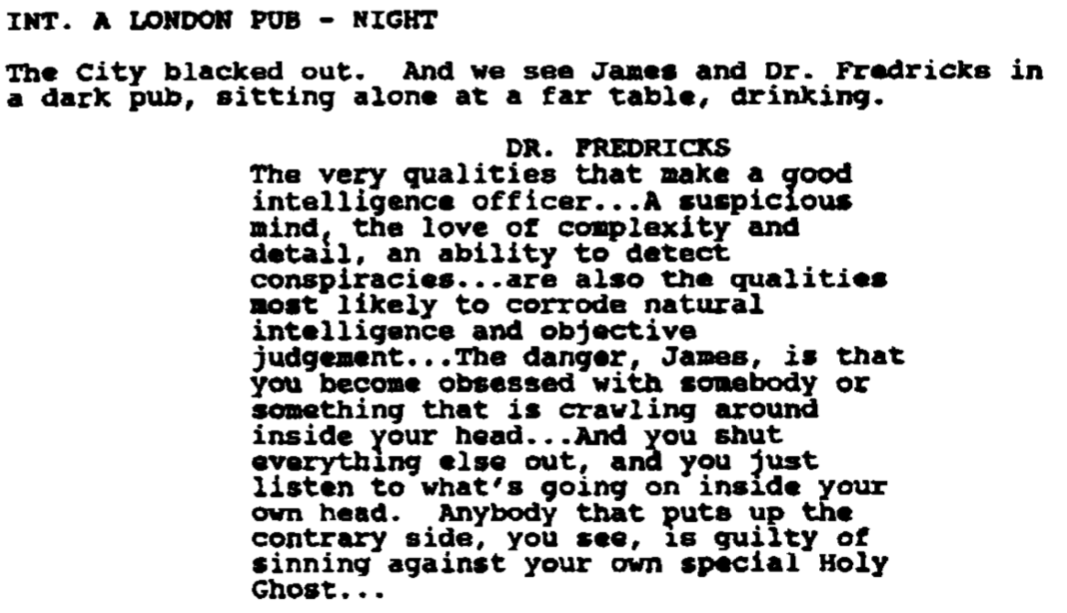
An excerpt from The Good Shepherd (2006) script:


The movie bombed, both at the box and among the critics. But I really like the script, so far.

Profile

timelets: (Default)
timelets

March 2026

S M T W T F S
1 2 34 5 67
8 9 101112 13 14
15 16 17 1819 20 21
22 23 2425 26 2728
293031    

Syndicate

RSS Atom

Most Popular Tags

Style Credit

Expand Cut Tags

No cut tags
Page generated Mar. 28th, 2026 05:29 am
Powered by Dreamwidth Studios