timelets: (Default)
“...from the eminent psychologist Jerome Bruner: “A good story and a well-formed argument are different natural kinds. Both can be used as means for convincing another. Yet what they convince of is fundamentally different: arguments convince one of their truth, stories of their lifelikeness. The one verifies by eventual appeal to procedures for establishing formal and empirical proof. The other establishes not truth but verisimilitude.”

“...from the American novelist and critic Ronald Sukenick: “All fiction can be profitably regarded as argument. When you define fiction by representation you end up confining it to realism at some level and arguing that fiction, as a form of make-believe, is a way of lying to get at the truth, which if not palpably stupid is certainly round-about and restrictive. My approach frees fiction from the obligations of mimesis, popularly, and most often critically, assumed to be its defining quality.”

An important qualification to this argument is that there is not necessarily any single privileged way of reading the conflict in a story, or sometimes even defining what or who it involves. This sounds extreme, but it can be especially true in longer and more complex narratives like the story of Oedipus.


--- Abbott, H. Porter. “The Cambridge Introduction to Narrative (Cambridge Introductions to Literature).”
timelets: (Default)
“under US law, the heavier narrative task is placed on the prosecution, who must not simply tell a story, but tell one that is complete. It must have a central figure, fully equipped “beyond a reasonable doubt” with the motivation, opportunity, means and capability to commit the crime – that is, to engage in a complete action with a beginning, a middle, and an end. ”

-- Abbott, H. Porter. “The Cambridge Introduction to Narrative (Cambridge Introductions to Literature).”
timelets: (Default)
“Books also had a “shelf life.” In a seventeenth-century bookseller’s shop, they could wait patiently for readers to come and purchase them. But staged plays were big events that happened at set times. They required an immense investment of both funds and labor: a paid company of actors and a theater, which must be built, purchased, or rented. They also needed to bring in the broadest cross-section of society if they were going to meet expenses. This difference in the technology and marketing of these two narrative media has only grown with time. ”

-- Abbott, H. Porter. “The Cambridge Introduction to Narrative (Cambridge Introductions to Literature).”


I wonder whether AI could close this gap.

p.s. a little bit later:
“...once revealed, the action of the story of the murder of Councilman Stubbs can be described in “terms of a linear chain: A->B->C->D (where D is the Death of Stubbs).
...
Characters are, usually, harder to understand than actions. They are themselves some of narrative’s most challenging gaps.
...
..we have to move from a horizontal to a vertical analysis, descending into the character to construct a plausible sense of her complexity.”

“The model, then, for the construct“tion of character in fictional narrative might look something like this:

reader/viewer + narrative -> reader/viewer’s construction of a character


In this view, a narrative can be represented by a product of Action and Character.
timelets: (Default)
“the way we usually behave when we interpret: that is, we usually assume that a narrative, like a sentence, comes from someone bent on communicating. The novelist Paul Auster put it simply: “In a work of fiction, one assumes there is a conscious mind behind the words on the page.”

--- Abbott, H. Porter. “The Cambridge Introduction to Narrative (Cambridge Introductions to Literature).”

>> this aasumption is no longer true. Copernicus showed that humans are not at the center of the universe. Darwin showed that humans are not at the center of biological world. LLMs show that humans are not at the center of the world of communications.

timelets: (Default)
“...the issue of closure. Probably the most difficult thing about reading narratives is to remain in a state of uncertainty. If a narrative won’t close by itself, one often tries to close it, even if it means shutting one’s eyes to some of the details and imagining others that aren’t there, underreading and overreading.

It is true, in fact, of our response to all but the shortest and simplest narrative texts.”

-- Abbott, H. Porter. “The Cambridge Introduction to Narrative (Cambridge Introductions to Literature).”
timelets: (Default)
“powerful narratives, don’t tell us what to think but cause us to think. Narrative as such, to borrow a line from I. A. Richards, is a “machine to think with.”

-- Abbott, H. Porter. “The Cambridge Introduction to Narrative (Cambridge Introductions to Literature).”
timelets: (Default)
How is it that half of America looks at Donald Trump and doesn’t find him morally repellent? He lies, cheats, steals, betrays, and behaves cruelly and corruptly, and more than 70 million Americans find him, at the very least, morally acceptable. Some even see him as heroic, admirable, and wonderful. What has brought us to this state of moral numbness?
...
the thinking of Alasdair MacIntyre, the great moral philosopher
...
As MacIntyre put it, “The choice between the ethical and the aesthetic is not the choice between good and evil, it is the choice whether or not to choose in terms of good and evil.”
...
How do people make decisions about the right thing to do if they are not embedded in a permanent moral order? They do whatever feels right to them at the moment. MacIntyre called this “emotivism,” the idea that “all moral judgments are nothing but expressions of preference, expressions of attitude or feeling.” Emotivism feels natural within capitalist societies, because capitalism is an economic system built around individual consumer preferences.

One of the problems with living in a society with no shared moral order is that we have no way to settle arguments. We have no objective standard by which to determine that one view is right and another view is wrong. So public arguments just go on indefinitely, at greater levels of indignation and polarization. People use self-righteous words to try to get their way, but instead of engaging in moral argument, what they’re really doing is using the language of morality to enforce their own preferences.

If no one can persuade anybody about right and wrong, then there are only two ways to settle our differences: coercion or manipulation.
...
Trump speaks the languages we moderns can understand. The language of preference: I want. The language of power: I have the leverage. The languages of self, of gain, of acquisition. He treats even the presidency itself as a piece of personal property he can use to get what he wants. As the political theorist Yuval Levin has observed, there are a lot of people, and Trump is one of them, who don’t seek to be formed by the institutions they enter. They seek instead to use those institutions as a stage to perform on, to display their wonderful selves.

-- David Brooks, 7/8/2025, the Atlantic.
https://www.theatlantic.com/ideas/archive/2025/07/trump-administration-supporters-good/683441/


Works well with Turchin's metaphor of musical chairs in politics/power.

TIL

Jul. 9th, 2025 09:21 am
timelets: (Default)
“Shakespeare surprised his audience with his version of the story in a way that we now cannot be surprised since we are so familiar with the tragic version. Later, in 1681, Nahum Tate rewrote the conclusion of King Lear, not only saving Cordelia’s life but also marrying her off to Edgar (who may not have been a prince but was certainly well born, unlike his wicked sibling). That version held the English stage for the next 160 years. Purists may object that this ruined the tragedy, but then Shakespeare could be said to have “ruined” Geoffrey of Monmouth’s King Leir when he decided to kill both Lear and Cordelia.”

--- Abbott, H. Porter. “The Cambridge Introduction to Narrative (Cambridge Introductions to Literature).”
timelets: (Default)
“..if change is inevitable, so too is recurrence. ”

--- Abbott, H. Porter. “The Cambridge Introduction to Narrative (Cambridge Introductions to Literature).”
timelets: (Default)
“The difference between events and their representation is the difference between story (the event or sequence of events) and narrative discourse (how the story is conveyed). The distinction is immensely important.

...when we read a narrative, we are aware of, on the one hand, the time of reading and the order in which things are read, and, on the other hand, the time the story events are supposed to take and the order in which they are supposed to occur.
...
We can squeeze a day’s worth of events into one sentence:

When I woke up, I packed two loaded guns and a ski mask, drove to the bank, robbed it, and was back in time for dinner.


Perhaps even more interestingly we can tell the same story backwards and still convey both the timing and the chronological sequence of events:

I was back in time for dinner, having robbed the bank to which I had driven with a ski mask and two loaded guns just after my nap.


We can also make many other changes in the narrative discourse and still deal with the same story. We can, for example, change the point of view (from first to third person) and expand the narrative discourse to dwell on a moment in the middle of this series of actions and still communicate with fidelity the same order of events:

He loved that old familiar, yet always strangely new, sensation of being someone else inside his ski mask, a pistol in each hand, watching the frightened teller count out a cool million. Nothing like it to wake a guy up. Nothing like it to give him a good appetite.


“The story can take a day, a minute, a lifetime, or eons. It can be true or false, historical or fictional. But insofar as it is a story, it has its own length of time and an order of events that proceeds chronologically from the earliest to the latest. The order of events and the length of time they are understood to take in the story are often quite different from the “time and order of events in the narrative discourse.”

...we take narrative to mean all modes of conveying stories.
...
So far we have established three distinctions: narrative is the representation of events, consisting of story and narrative discourse; story is an event or sequence of events (the action); and narrative discourse is those events as represented.

...storyworld should be considered a third defining feature of narrative along with story and narrative discourse.

Abbott, H. Porter. “The Cambridge Introduction to Narrative (Cambridge Introductions to Literature).”
timelets: (Default)
There once was an old Bedouin, who, sensing that his death was imminent,
gathered together his three sons and signified his last wishes to
them. To the eldest, he bequeathed half his inheritance, to the second one
quarter, and to the third one sixth. As he said this, he died, leaving his sons
in perplexity, for the inheritance in question consisted of eleven camels.
How were they to respect the old man's will ? Should they kill those of
the camels whose division seemed prescribed, and share the meat among
them ? Was this the required filial piety? Did their father really want them to
prove their love by accepting this loss? Or had he made a mistake, distracted
or weakened by his imminent death ? In fact, at least one error was
obvious, because one-half plus a quarter plus a sixth do not make one.

Yetto inherit on the basis of an interpretation that disqualifies a last wish, is
this not to insult to the dead? And in this case, moreover, how could one
divide ? Who would take away the remainder of the division ? All the ingredients
were there for a fratricidal war. The three brothers nevertheless
decided to try to avoid the war, that is, to wager that a solution could
exist. This means that they went to see the old sage who so often plays a
role in such stories. This old sage, on this occasion, told them that he
could not do anything for them except to offer them what might perhaps
help them: his old camel, skinny and half-blind. The inheritance now
counted twelve camels: the eldest took six of them, the second three, the
youngest two, and the old camel was returned to the old sage.

What did the twelfth camel accomplish ? By its presence, it made possible
what seemed contradictory, simultaneously obeying the father's wishes,
discovering the possi bility of respecting their terms, and not destroying
the value of the inheritance.

--- I.Stengers, Thinking with Whitehead


I'm going to steal this parable from her.
timelets: (Default)
...part of Trump’s psychological abuse is wearing down opponents so they stop repeating themselves, and give in to the lies. I will not be worn down. Truth matters.

Here it is: We have a sociopathic president in total command of a cult-like party; a Congress that, as long as the GOP controls it, is a rubber-stamp version of the Russian Duma under Putin; a court balanced precariously between a modest defense of the unitary executive and an Alito wing bent on empowering an American Caesar; and a Justice Department openly planning persecution of the president’s political opponents.

https://andrewsullivan.substack.com/p/the-bully-in-his-pulpit-0e5

Good point. We should not become numb to the basic truths of the situation. Rather, we should take Canada as an example of a society united against shameless assholes abusing their power in the US.

timelets: (Default)
Here's an interesting way to make a connection between Peirce's pragmatism/logic and the category theory


Link to the paper https://ncatlab.org/davidcorfield/files/Peirce200225.pdf
timelets: (Default)


Among other things, the ant solution to the grain sorting problem given to Psyche by Aphrodite can be modeled as a replacement of an Inert with an Active. The same applies to the Trasnsformer solution of the translation problem, etc.

upd. the Odysseus solution to the Sirens problem also fits the pattern
timelets: (Default)
Сказка про голого короля (королеву) больше не актуальна.

Бьянка Сенсори, жена Йе, пришла на Grammys голой.

https://www.the-sun.com/entertainment/13438622/bianca-censori-nude-grammys-red-carpet-dress-kanye-west/
timelets: (Default)
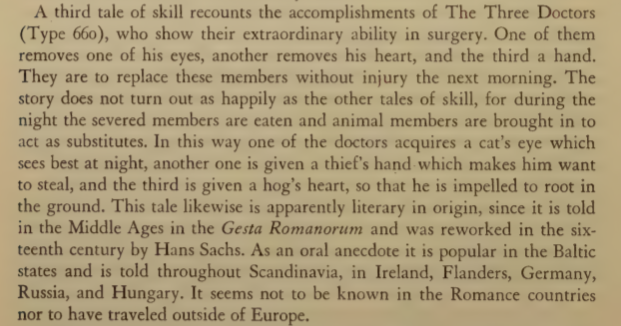
“Folktales are real (le fiabe sono vere)” [Calvino]

The structures of wonder and magic open ways of recording experience while imagining a time when suffering will be over. Fate will be changed; perpetrators overcome. The wishful thinking and the happy ending are rooted in sheer misery.


Unlike myths, which are about gods and superheroes, fairytale protagonists are recognizably ordinary working people, toiling at ordinary occupations over a long period of history, before industrialization and mass literacy.

-- Warner, Marina;. “Once upon a Time.”
timelets: (Default)
"In The Invention of Literature (1999), the classical scholar Florence Dupont reminds us that many of the greatest works of human imagination were created to be performed, to be heard.

Before the printing press and mass literacy, the written versions existed as blueprints or records of performances, recitals, speeches, songs, and other forms of oral communication. Voicing was an art of living creators, and the voice of the storyteller was polyphonous; the stories created were all different and the same at one and the same time—again the fairy tale as tune, riffed by singers or instrumentalists. Every listener is potentially a new storyteller. Early literature was not composed of fixed texts, but of play scripts and prompt books, storytellers’ scrolls, pattern books. ”

-- Warner, Marina;. “Once upon a Time.”
timelets: (Default)


How do we measure fitness of a technology startup as a function of time/stage? Rapid positive changes in fitness would be considered value inflection points.

Also, rapid changes in fitness due to new entrants can be easily detected. For example, in the Three Little Pigs story, the appearance of the wolf impacts fitness distribution and as a result changes ROI of house-construction tech.
timelets: (Default)


https://arxiv.org/abs/2008.02394

Need to play with the idea. We can probably glue together narratives as graphs.

upd: The Algebra of Open and Interconnected Systems.

https://arxiv.org/pdf/1609.05382
timelets: (Default)
About the Grimm Brothers:
“In 1812, the first edition of their anthology, comprising eighty-six stories, came out in an edition of 600, with an apparatus of notes running to hundreds of pages. It was not really intended to be read for pleasure at all by the children and households of its title; it was a learned work setting out to reconfigure the cultural history of Germany along lines that would emancipate it from the monopoly of classical and French superiority. Yet this collection—by the final, standard edition of 1857 the number of tales had grown to 210—was to become the most widely translated work in the world after the Bible and the Qur’an, rendered into more than 160 languages so far, including Xhosa and Tagalog, and still counting.”
...
"Germany wasn’t yet Germany. It was a congeries made up of dozens of principalities and archdukedoms, free Hanseatic ports and archbishoprics. History shows us that the modern nation-state develops long after a national culture and its language: think of Italy and of Dante, writing five hundred years before Italian unification. For centuries, “most of the peninsula had been under German or Austrian or Spanish rule, while the Renaissance, indisputably Italian, was influencing the whole world. The Grimms were living in a time of turmoil and bloodshed. ”
...
“One response to humiliation is to assert cultural riches and distinctiveness, even pre-eminence. ”

--- Warner, Marina;. “Once upon a Time."

Profile

timelets: (Default)
timelets

December 2025

S M T W T F S
  12 3456
78910111213
14 151617 18 19 20
21 222324252627
28293031   

Syndicate

RSS Atom

Most Popular Tags

Style Credit

Expand Cut Tags

No cut tags
Page generated Dec. 30th, 2025 10:39 am
Powered by Dreamwidth Studios