(no subject)
Jul. 10th, 2025 09:07 amHow is it that half of America looks at Donald Trump and doesn’t find him morally repellent? He lies, cheats, steals, betrays, and behaves cruelly and corruptly, and more than 70 million Americans find him, at the very least, morally acceptable. Some even see him as heroic, admirable, and wonderful. What has brought us to this state of moral numbness?
...
the thinking of Alasdair MacIntyre, the great moral philosopher
...
As MacIntyre put it, “The choice between the ethical and the aesthetic is not the choice between good and evil, it is the choice whether or not to choose in terms of good and evil.”
...
How do people make decisions about the right thing to do if they are not embedded in a permanent moral order? They do whatever feels right to them at the moment. MacIntyre called this “emotivism,” the idea that “all moral judgments are nothing but expressions of preference, expressions of attitude or feeling.” Emotivism feels natural within capitalist societies, because capitalism is an economic system built around individual consumer preferences.
One of the problems with living in a society with no shared moral order is that we have no way to settle arguments. We have no objective standard by which to determine that one view is right and another view is wrong. So public arguments just go on indefinitely, at greater levels of indignation and polarization. People use self-righteous words to try to get their way, but instead of engaging in moral argument, what they’re really doing is using the language of morality to enforce their own preferences.
If no one can persuade anybody about right and wrong, then there are only two ways to settle our differences: coercion or manipulation.
...
Trump speaks the languages we moderns can understand. The language of preference: I want. The language of power: I have the leverage. The languages of self, of gain, of acquisition. He treats even the presidency itself as a piece of personal property he can use to get what he wants. As the political theorist Yuval Levin has observed, there are a lot of people, and Trump is one of them, who don’t seek to be formed by the institutions they enter. They seek instead to use those institutions as a stage to perform on, to display their wonderful selves.
-- David Brooks, 7/8/2025, the Atlantic.
https://www.theatlantic.com/ideas/archive/2025/07/trump-administration-supporters-good/683441/
Works well with Turchin's metaphor of musical chairs in politics/power.
(no subject)
Jun. 14th, 2025 11:11 amThe transition from the ‘red’ of awareness to the ‘red’ of thought is accompanied by a definite loss of content, namely by the transition from the factor ‘red’ to the entity ‘red.’ This loss in the transition to thought is compensated by the fact that thought is communicable whereas sense-awareness is incommunicable.
-- Whitehead, The Concept of Nature.
https://www.gutenberg.org/files/18835/18835-h/18835-h.htm
This is different for AI. Even more specifically, Jeff Dean introduced a mode of "teacher-student" transmission where both weights and elements of the model transferred between entities.
(no subject)
Jun. 10th, 2025 05:27 pmI find it really productive to think about different types of AI/ML using one of Whitehead's approaches. For example, he describes three elements of any event: physical prehension (objective data), cognitive prehension (eternal possibilities), decision. Implicitly, when we talk about an agent, the fourth element is realization, i.e. action on the decision. (upd. he also has _subjective aim_, which is the target of the decision).
Each of these elements carries modes of interaction that are fundamentally different for humans and ML. First of all, physical prehension, i.e. awareness of the world, involves radically different sensory methods. Furthermore, while human awareness relies on analog biological, evolutionary fixed senses, ML can access digital non-biological signals. Further, its awareness can be retrained on new data gathering methods. Moreover, various types of ML can be trained and retrained on new senses just like we train dogs for tracking. The possibilities for creating new types of world awareness are mind boggling.
Etc, etc, etc.
Also, Whitehead's theology is highly applicable to this subject, but I'd need more time to study and think about it.
upd: transparency of prehension would be a good topic on which to "compare and contrast"
Each of these elements carries modes of interaction that are fundamentally different for humans and ML. First of all, physical prehension, i.e. awareness of the world, involves radically different sensory methods. Furthermore, while human awareness relies on analog biological, evolutionary fixed senses, ML can access digital non-biological signals. Further, its awareness can be retrained on new data gathering methods. Moreover, various types of ML can be trained and retrained on new senses just like we train dogs for tracking. The possibilities for creating new types of world awareness are mind boggling.
Etc, etc, etc.
Also, Whitehead's theology is highly applicable to this subject, but I'd need more time to study and think about it.
upd: transparency of prehension would be a good topic on which to "compare and contrast"
(no subject)
Jun. 7th, 2025 02:58 pmThere once was an old Bedouin, who, sensing that his death was imminent,
gathered together his three sons and signified his last wishes to
them. To the eldest, he bequeathed half his inheritance, to the second one
quarter, and to the third one sixth. As he said this, he died, leaving his sons
in perplexity, for the inheritance in question consisted of eleven camels.
How were they to respect the old man's will ? Should they kill those of
the camels whose division seemed prescribed, and share the meat among
them ? Was this the required filial piety? Did their father really want them to
prove their love by accepting this loss? Or had he made a mistake, distracted
or weakened by his imminent death ? In fact, at least one error was
obvious, because one-half plus a quarter plus a sixth do not make one.
Yetto inherit on the basis of an interpretation that disqualifies a last wish, is
this not to insult to the dead? And in this case, moreover, how could one
divide ? Who would take away the remainder of the division ? All the ingredients
were there for a fratricidal war. The three brothers nevertheless
decided to try to avoid the war, that is, to wager that a solution could
exist. This means that they went to see the old sage who so often plays a
role in such stories. This old sage, on this occasion, told them that he
could not do anything for them except to offer them what might perhaps
help them: his old camel, skinny and half-blind. The inheritance now
counted twelve camels: the eldest took six of them, the second three, the
youngest two, and the old camel was returned to the old sage.
What did the twelfth camel accomplish ? By its presence, it made possible
what seemed contradictory, simultaneously obeying the father's wishes,
discovering the possi bility of respecting their terms, and not destroying
the value of the inheritance.
--- I.Stengers, Thinking with Whitehead
I'm going to steal this parable from her.
(no subject)
Jun. 7th, 2025 10:59 amА. Воробей недавно написал, что разрешает себе писать о политике только если, как минимум, час позанимался физикой или математикой. https://avva.dreamwidth.org/3576932.html
Это хорошее правило. Для меня этот час будет включать философию — начал читать книгу Isabelle Stengers "Thinking with Whitehead: free and wild creation of concepts."
Misplaced concretenes
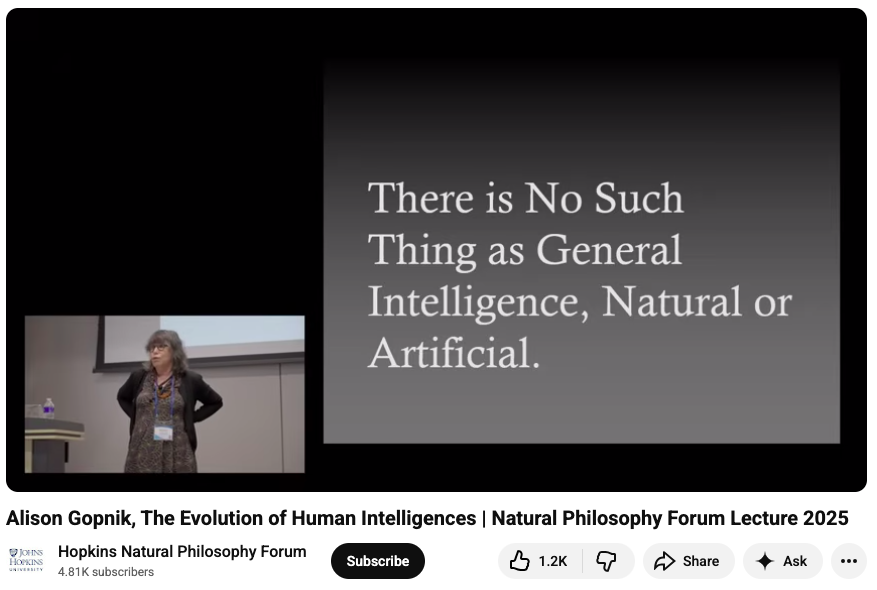
May. 30th, 2025 05:43 pmMost discussions about AI, especially AGI, suffer from what Whitehead would call the Fallacy of Misplaced Concreteness. That is, people assume that Intelligence is something concrete existing in Nature that can be easily pointed to and described. Instead, we have a broad range of definitions covering various bundles of human and/or computer capabilities.
By contrast, discussions about industrial robots, including drones and autonomous cars, are usually much more productive because their roles are well specified in terms of tasks and accomplishments.
Here's an interesting way to make a connection between Peirce's pragmatism/logic and the category theory
Link to the paper https://ncatlab.org/davidcorfield/files/Peirce200225.pdf
(no subject)
Feb. 18th, 2025 10:28 pmWhat Nagel has discovered is a fascinating architectural feature of the human mind: We are beings who can representationally distance ourselves from ourselves and make this fact globally avail- able through conscious experience.
-- Thomas Metzinger, Being No One. 2004
Nagel's book View From Nowhere is going to be next on my reading list
Quote of the Day
Feb. 4th, 2025 08:39 pmPhilosophical problems can frequently be solved by conceptual analysis or by transforming them into more differentiated versions. However, an additional and interesting strategy consists in attempting to also uncover their introspective roots. A careful inspection of these roots may help us to understand the intuitive force behind many bad arguments, a force that typically survives their rebuttal.
--- Thomas Metzinger, Being No One, 2004.
(no subject)
Feb. 3rd, 2025 11:41 pm( Read more... )
However, this would require shifting incentives away from maximizing engagement and toward epistemic responsibility, which is difficult given current business models.
====
It would be an interesting challenge to come with up a technology and a business model that solves the problem.
Also related https://youtu.be/qlPHGnChhI4?si=03mDoaAYAFJnEfCE&t=4004
truth conditions (theoretical intentionality) vs satisfaction conditions (practical intentionality)
However, this would require shifting incentives away from maximizing engagement and toward epistemic responsibility, which is difficult given current business models.
====
It would be an interesting challenge to come with up a technology and a business model that solves the problem.
Also related https://youtu.be/qlPHGnChhI4?si=03mDoaAYAFJnEfCE&t=4004
truth conditions (theoretical intentionality) vs satisfaction conditions (practical intentionality)
Quote of the day
Feb. 3rd, 2025 05:32 pmThe American composer, artist, and music theorist John Cage (1912–1992) wrote
about a sudden philosophical insight that he had in the late 1940s during an experi-
ment in the anechoic chamber at Harvard University. He described it like this: “[S]ilence
is not acoustic. It is a change of mind, a turning around.”
--- Thomas Metzinger, The Elephant and the Blind. 2024.
=====
His comparison of meditation experience to silence feels right. It's not like any other exprience, even if we say it's like flying or swimming or resting. On my smartwatch it registers as deep sleep, but I know I'm not sleeping; rather, I feel that the world around me goes into quetude of almost non-existence.
about a sudden philosophical insight that he had in the late 1940s during an experi-
ment in the anechoic chamber at Harvard University. He described it like this: “[S]ilence
is not acoustic. It is a change of mind, a turning around.”
--- Thomas Metzinger, The Elephant and the Blind. 2024.
=====
His comparison of meditation experience to silence feels right. It's not like any other exprience, even if we say it's like flying or swimming or resting. On my smartwatch it registers as deep sleep, but I know I'm not sleeping; rather, I feel that the world around me goes into quetude of almost non-existence.
(no subject)
Nov. 23rd, 2024 08:35 pm“Fairy tales operate according to several other fundamental principles of magical thinking besides natural magic and animist vitality: animal metamorphosis and changeable bodies on the one hand, and the binding power of promises and curses on the other, govern the logic of the plots—although logic is hardly the mot juste, since magic springs continual surprises that break all the rules of probability. The implied, ever-present possibility of transmogrification means that fairytale protagonists...may be changed, sometimes literally, sometimes figuratively. A stroke of fate will raise them high or lay them low.
Although magic operates according to fundamental principles, its manifestations differ from culture to culture, and era to era, which adds spice and variety to fairy tales.”
...
The stress falls on the binding power of words: the father must keep his promise to the Beast, the beauty will sleep for a hundred years, according to the letter of the spell.
...
“Prophecies—and curses—march on unstoppably. One message of fairy tales is ‘Beware what you wish for.’ Another would be ‘Beware what you promise.’ Yet another would be ‘Beware what you utter.’ You can’t take back what you say. There’s a profound respect in the genre for what words do in the world, as well as in the stories.”
--Warner, Marina;. “Once upon a Time.”
=====
Promises create a stable structure, while everything else is changeable. This way "what is" and "what ought to be" ultimately are the same.
Although magic operates according to fundamental principles, its manifestations differ from culture to culture, and era to era, which adds spice and variety to fairy tales.”
...
The stress falls on the binding power of words: the father must keep his promise to the Beast, the beauty will sleep for a hundred years, according to the letter of the spell.
...
“Prophecies—and curses—march on unstoppably. One message of fairy tales is ‘Beware what you wish for.’ Another would be ‘Beware what you promise.’ Yet another would be ‘Beware what you utter.’ You can’t take back what you say. There’s a profound respect in the genre for what words do in the world, as well as in the stories.”
--Warner, Marina;. “Once upon a Time.”
=====
Promises create a stable structure, while everything else is changeable. This way "what is" and "what ought to be" ultimately are the same.
(no subject)
Nov. 17th, 2024 11:31 pmwhen people thought the earth was flat, they were wrong. When people thought the earth was spherical, they were wrong. But if you think that thinking the earth is spherical is just as wrong as thinking the earth is flat, then your view is wronger than both of them put together.
The basic trouble, you see, is that people think that "right" and "wrong" are absolute; that
everything that isn't perfectly and completely right is totally and equally wrong.
--- Asimov, The Relativity of Wrong. Source: The Skeptical Inquirer, Vol. 14 No. 1, Fall 1989, pp. 35-44.
The basic trouble, you see, is that people think that "right" and "wrong" are absolute; that
everything that isn't perfectly and completely right is totally and equally wrong.
--- Asimov, The Relativity of Wrong. Source: The Skeptical Inquirer, Vol. 14 No. 1, Fall 1989, pp. 35-44.
(no subject)
Sep. 18th, 2024 08:25 pmPhilosophy can exclude nothing.
...before the work of systematization commences, there is a previous task—a very necessary task if we are to avoid the narrownesses inherent in all finite systems... [this] primary stage can be termed 'assemblage'.
...the philosophic process of assemblage should have received some attention from every educated mind, in its escape from its own specialism.
In Western Literature there are four great thinkers, whose services to civilized thought rest largely upon their achievements in philosophical assemblage; though each of them made important contributions to the structure of philosophic system. These men are Plato, Aristotle, Leibniz, and William James.
...
William James, essentially a modern man. His mind was adequately based upon the learning of the past. But the essence of his greatness was his marvellous sensitivity to the ideas of the present. He knew the world in which he lived, by travel, by personal relations with its leading men, by the variety of his own studies. He systematized; but above all he assembled. His intellectual life was one protest against the dismissal of experience in the interest of system. He had discovered intuitively the great truth with which modern logic is now wrestling.
...
One characteristic of the primary mode of conscious experience is its fusion of a large generality with an insistent particularity.
...
In order to acquire learning, we must first shake ourselves free of it. We must grasp the topic in the rough, before we smooth it out and shape it. For example, the mentality of John Stuart Mill was limited by his peculiar education which gave him system before any enjoyment of the relevant experience. Thus his systems were closed. We must be systematic; but we should keep our systems open. In other words, we should be sensitive to their limitations. There is always a vague 'beyond', waiting for penetration in respect to its detail.
--- Whitehead.
https://brocku.ca/MeadProject/Whitehead/Whitehead_1938/1938_01.html
...before the work of systematization commences, there is a previous task—a very necessary task if we are to avoid the narrownesses inherent in all finite systems... [this] primary stage can be termed 'assemblage'.
...the philosophic process of assemblage should have received some attention from every educated mind, in its escape from its own specialism.
In Western Literature there are four great thinkers, whose services to civilized thought rest largely upon their achievements in philosophical assemblage; though each of them made important contributions to the structure of philosophic system. These men are Plato, Aristotle, Leibniz, and William James.
...
William James, essentially a modern man. His mind was adequately based upon the learning of the past. But the essence of his greatness was his marvellous sensitivity to the ideas of the present. He knew the world in which he lived, by travel, by personal relations with its leading men, by the variety of his own studies. He systematized; but above all he assembled. His intellectual life was one protest against the dismissal of experience in the interest of system. He had discovered intuitively the great truth with which modern logic is now wrestling.
...
One characteristic of the primary mode of conscious experience is its fusion of a large generality with an insistent particularity.
...
In order to acquire learning, we must first shake ourselves free of it. We must grasp the topic in the rough, before we smooth it out and shape it. For example, the mentality of John Stuart Mill was limited by his peculiar education which gave him system before any enjoyment of the relevant experience. Thus his systems were closed. We must be systematic; but we should keep our systems open. In other words, we should be sensitive to their limitations. There is always a vague 'beyond', waiting for penetration in respect to its detail.
--- Whitehead.
https://brocku.ca/MeadProject/Whitehead/Whitehead_1938/1938_01.html
(no subject)
Sep. 14th, 2024 07:53 pmThere is an insistent presupposition continually sterilizing philosophic thought. It is the belief, the very natural belief, that mankind has consciously entertained all the fundamental ideas which are applicable to its experience. Further it is held that human language, in single words or in phrases, explicitly expresses these ideas. I will term this presupposition, The Fallacy of the Perfect Dictionary.
--- Whitehead.
https://brocku.ca/MeadProject/Whitehead/Whitehead_1938/1938_09.html
We might be committing this fallacy wrt ML.
(no subject)
Sep. 13th, 2024 07:53 pmThe only intelligible doctrine of causation is founded on the doctrine of immanence. Each occasion presupposes the antecedent world as active in its own nature. This is the reason why events have a determinate status relatively to each other. ( Read more... )
-- AF Whitehead, Modes of Thought, Lecture 8.
https://brocku.ca/MeadProject/Whitehead/Whitehead_1938/1938_08.html
-- AF Whitehead, Modes of Thought, Lecture 8.
https://brocku.ca/MeadProject/Whitehead/Whitehead_1938/1938_08.html
(no subject)
Sep. 8th, 2024 09:00 pmThe sharp-cut scientific classifications are essential for scientific method. But they are dangerous for philosophy. Such classification hides the truth that the different modes of natural existence shade off into each other.
There is the animal life with its central direction of a society of cells, there is the vegetable life with its organized republic of cells, there is the cell life with its organized republic of molecules, there is the large-scale inorganic society of molecules with its passive acceptance of necessities derived from spatial relations, there is the infra-molecular activity which has lost all trace of the passivity of inorganic nature on a larger scale.
Whitehead. Modes of Thought, Chapter 8, Nature Alive. 1938.
https://brocku.ca/MeadProject/Whitehead/Whitehead_1938/1938_08.html