timelets: (Default)
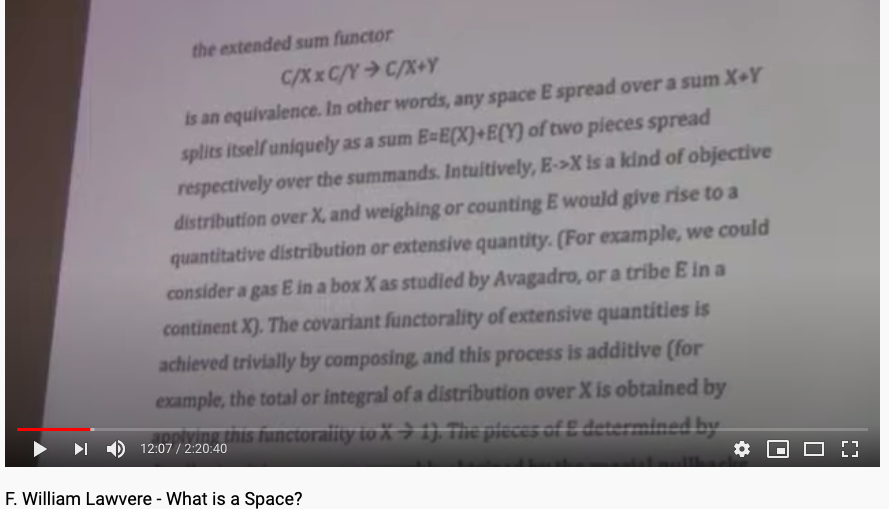
I keep coming back to this video about the relationship between (pre-)sheafs and cohomology. Here he says that "the number one technique in mathematics is turning any problem into a linear algebra problem.

More generally, Lawvere often talks about mapping geometry to algebra.

https://youtu.be/RPuWHN0BTio?si=U0h7YM-3GlcyvnS5&t=1890


D --> J <-- T ( c: D --> T is the solution to a choice problem, per Lawvere).

d: D --> J
e: T --> J
c: D --> T

This diagram is a regular Kan extension problem, with a cohomology twist, i.e. assigning values to both objects and arrows.
timelets: (Default)
...dynamic processes give rise to particular growth patterns: branching out whilst foraging (to maximize coverage of territory) and forming networks once nodes have been established (to strengthen connections and facilitate the transfer of information). Branching is a fundamental strategy within myriad biological organisms and physical phenomena, from the bifurcation of river deltas, lightning strikes, tree roots and branches, to mycelial networks and in our own bodily systems including blood vessel networks and the cross channelling of neural pathways. Branching facilitates ‘the transmission and parsing of information, no less than the transfer and dissipation of energy’ and, according to philosopher Stephen Shaviro, ‘is an essential process of Nature’ (Shaviro, 2016: 220).

Drawing Processes of Life, 2024.


Again, branching and consolidation can be represented as critical points in Morse-Smale theory. https://timelets.dreamwidth.org/1568281.html

In a narrative, a character can create a branch, thus diverting the flow of events to their advantage or disadvantage. For example, in the LRRH fairy tale the Wolf diverts the girl's attention to beautiful flowers and gains power over her future. It takes magic to undo his villainy.
An example of a positive diversion would be Царевна-Лягушка, where the ugly frog bride tells the prince to get some sleep while she takes care of the king's challenge.

In social theory, topology-based approach to agency can help model the difference between democratic elections and sociological polling for potential course corrections in authoritarian regimes, like the Putin's (see, e.g. Spin Dictators, by Guriev and Treismann).

M&A narratives and consequences can be treated the same way.

upd. Kan extensions/lifts can be used to represent branching/consolidation patterns.

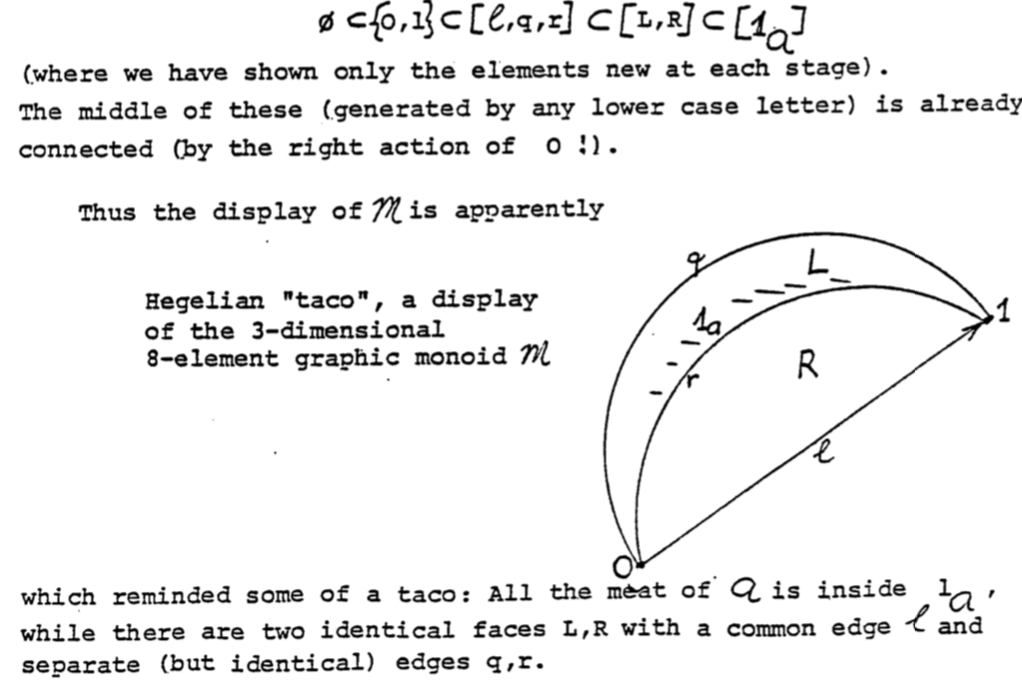
upd 1. Does it apply to Lawvere's Hegelian Taco?

timelets: (Default)
“...posted a much higher rate of tickets per transaction compared with typical movies, meaning more people are seeing it in big groups, The Box Office Company said.

It’s unprecedented to see presales like this for an original comedy,” said Marine Suttle, the company’s chief product officer. “It’s performing like a superhero movie.”

https://www.wsj.com/articles/barbenheimer-poised-to-deliver-blowout-weekend-at-the-box-office-9feef168


An interesting FOM: tickets per transaction. (an intensive quantity in Lawvere).
timelets: (Default)
When in doubt build a model based on the Kan extension. Or at least, use Lawvere's simplified version of it ( determination/choice).


* Questions (A) -> Little Red Riding Hood (B) -> Learning [Wolf Detection] (C)

A -> C maps to False ( A -> Ω), which hints at the idea that marginal knowledge can be modeled as a topos. We can also show the nature of the transition from Google Search to GPT.

* All objects are marginal.
timelets: (Default)
Social learning. Our species is the only one that voluntarily shares information: we learn a lot from our fellow humans through language.

“ In our brains, by contrast, the highest-level information, which reaches our consciousness, can be explicitly stated to others. Conscious knowledge comes with verbal reportability: whenever we understand something in a sufficiently perspicuous manner, a mental formula resonates in our language of thought, and we can use the words of language to report it. ”


One-trial learning. An extreme case of this efficiency is when we learn something new on a single trial. If I introduce a new verb, let’s say ”

“To learn is to succeed in inserting new knowledge into an existing network.”

--- Stanislas Dehaene. “How We Learn.”


The combination of the two modes of learning creates a cascading effect.

We can model this as a change of state, e.g. learning-by-doing by a pair of individuals, wherein the first one is doing, while the second one ("the soul") is learning. That is, TLRRH starts naive and dies while going to her grandma. At the same time, we, the observers, learn from her one-time misfortune and pass this learning to future generations.

Also related: fool me once, shame on you; fool me twice, shame on me.


timelets: (Default)
“ ...to learn is to form an internal model of the external world.”

--- Stanislas Dehaene. “How We Learn.”


Note that he either externalizes confirmation of the model or considers its confirmation to be a part of formation. (upd. via trial and error).

cf: Lawvere's rough sketch of mathematical thinking where confirmation can be made explicit.

timelets: (Default)
This is an important insight: comma categories always have a terminal object. Now, I can relate it to Lawvere's interpretation of Hegel's logic.


"If X is any application of the graphic G , then the "comma" category G/X (whose objects are the elements of X and whose morphisms determine the action via the discrete fibration property of the labelling functor G/X -> G ) is again a graphic. Thus each particular application X of G provides one way G'-> G of expanding the graphic G into a more detailed graphic G' " -- Lawvere, Hegelian Taco.
timelets: (Default)
By a graphic we will mean any finite category each of whose endomorphism monoids satisfies the identity xyx = xy ; in particular, a graphic monoid is a graphic category with one object.
By an application of a graphic category we will mean any right action of it on finite sets (i.e. any contravariant finite-set- valued functor on it).
-- Lawvere, The Hegelian "Taco", 1989.


I think social networking satisfies this requirement, e.g. Make Use Make = Make Use (a user to Make a new user).
timelets: (Default)
Similar to the way in which Bergson contrasts time and duration, intellect and intuition, Péguy differentiates between history and tradition, science and experience. To illustrate this difference, for example, in Clio history is compared to a long railway line that runs along the coast and that allows one to stop at any station one wishes. In this metaphor tradition—collective memory—appears as the coast, with its marshes, people, fishes, estuaries of rivers and streams, as life on land and life in the sea.
Read more... )
--- Heoning Schmidgen. Bruno Latour in Pieces, 2014.


In contrast with schoolbook history that treats its subject as tourism, he thinks about it as travel, similar to the original approach introduced by Herodotus more than two thousand years ago.

Also see Lawvere, Categories of Space and Quantity, 1992, wrt the example of a sojourn, as a variable intensive quantity. Peguy's history vs a schoolbook one would have a completely different intensive quantity pattern, while the terminal object in the underlying extensive category, i.e. the total would be the same.
timelets: (Default)
This use of 1, 2, 2 x 2, is based on the insight that these very simple categories are ‘basic figure shapes’ for the analysis of general categories; it is an example of a general
method for analyzing the ‘inside’ of objects in any category

--- Lawvere & Schanuel. Conceptual Mathematics, 2009. p 370.


In the context of Lawvere's 1992 paper "Categories of Space and Quantity", 1 represents being; 2 - becoming; 2x2 – coherent scenarios of becoming, with a natural transformation between them (theories).
timelets: (Default)
Gradations,


--- John Lewis Gaddis. “On Grand Strategy.”


Hegel formalized this approach later in his The Science of Logic. Also, see W.Lawvere's "Display of graphics and their applications, as exemplified by 2-categories and the Hegelian "taco."
https://ncatlab.org/nlab/show/Hegelian+taco
timelets: (Default)
Lawvere's Hegelian Taco https://apps.dtic.mil/sti/pdfs/ADA360121.pdf
Retrieving stored knowledge presupposes some consciousness of the structure it has; this structure is in its particularity fixed by the storage process itself (and in its generality is partly a reflection of the content, i.e. of the nature of the knowledge stored). Thus in both retrieval and storage one needs to be explicitly aware of the kind of structure involved.

Lot's to learn here.
timelets: (Default)
Before I forget,

s: P -> D;
t: P -> D;
j: P -> D;
a1: P -> C;
a2; D -> C.

F: C -> Ω (quantity type functor).

C can be thought of as J2BD.

In a simplest case, P = D; therefore, the model collapses to P -> C and becomes a choice problem wrt f: X -> P, wherein X -> C and P -> C are given.
timelets: (Default)
Interesting.


-- Reyes, et. al., Generic figures and their glueings. 2004.

Read more... )
timelets: (Default)
Usually the key aspect of an action of some X is that X itself carries an algebraic structure, such as being a group (or just a monoid) or being a ring or an associative algebra, which is also possessed by Y^Y and preserved by the curried action \widehat{act}. Note that if Y is any set then Y^Y is a monoid,

https://ncatlab.org/nlab/show/action

also see Lawvere, 1986

"Historically the notion of monoid (or of group in particular) was abstracted from the actions, a pivotally important abstraction since as soon as a particular action is constructed or noticed, the demands of learning, development, and use mutate it into: 1) other actions on the same object, 2) actions on other related objects, and 3) actions of related monoids. "


===
MxA->
 A

UxA -> A
timelets: (Default)
...it is the mutability of mathematically precise structures (by morphisms) which is the essential content of category theory. If the structures are themselves categories, this mutability is expressed by functors, while if the structures are functors, the mutability is expressed by natural transformations.

--- F. William Lawvere, 2005.
timelets: (Default)
Just to think of it:
Then in 1963 Lawvere embarked on the daring project of a purely categorical foundation for all mathematics.

Profile

timelets: (Default)
timelets

December 2025

S M T W T F S
  12 3456
78910111213
14 151617 18 19 20
21 222324252627
28293031   

Syndicate

RSS Atom

Most Popular Tags

Style Credit

Expand Cut Tags

No cut tags
Page generated Dec. 24th, 2025 04:50 am
Powered by Dreamwidth Studios