timelets: (Default)

Что же здесь происходит? Почему нужно избушку повернуть? Почему нельзя войти просто? Часто перед Иваном гладкая стена
— «без окон без дверей» — вход с противоположной стороны. «У этой избушки ни окон, ни дверей, — ничего нет» (17). Но отчего же не обойти избушки и не войта с той стороны? Очевидно, этого нельзя. Очевидно, избушка стоит на какой-то такой види- мой или невидимой грани, через которую Иван никак не может перешагнуть. Попасть на эту грань можно только через, сквозь избушку, и избушку нужно повернуть, «чтобы мне зайти и выйти»

-- В. Пропп. Исторические корни волшебной сказки.


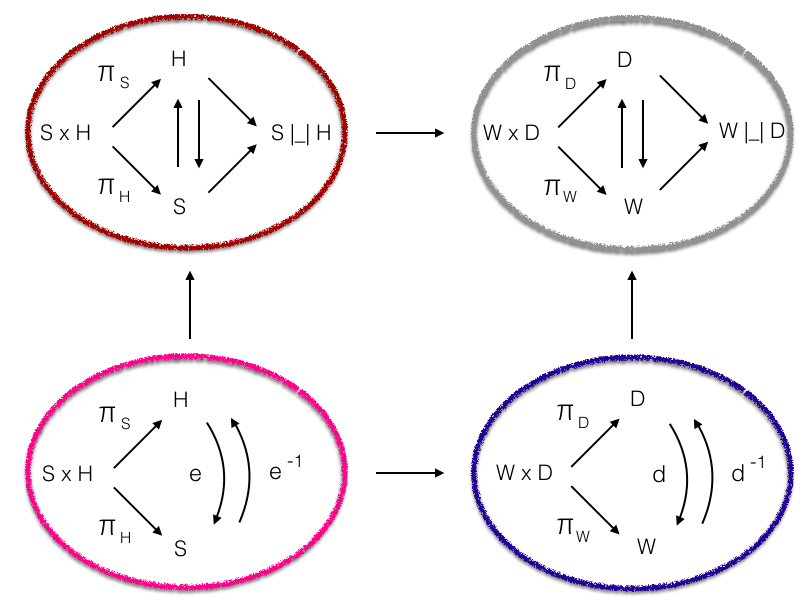
I never thought about избушка as an interface, an airlock, between spaces. We could probably model it as a pushout.

Another interesting observation:
Слеп человек не сам по себе, а по отношению к чeму-нибудь. Под «слепотой» может быть вскрыто понятие некоторой обоюдности невидимости.

...
Герой все это знает, потому что он г е р о й . Геройство его и состоит в его магическом знании, в его силе.
Вся эта система испытания отражает древнейшие представления о том, что подобно тому, как магически можно вызвать дождь или заставить зверя идти на ловца, можно вынудить вход в иной мир. Дело вовсе не в «добродетели» и «чистоте», а в силе.
timelets: (Default)
Paraphrasing Kant, [Two things fill the mind with ever new and increasing admiration and awe, the more often and steadily we reflect upon them:] limits and co-limits."
timelets: (Default)
“...he [Lincoln] managed polarities: they didn’t manage him.
...
Scale sets the ranges within which experience accrues. If, in evolution, edges of chaos reward adaptation; if, in history, adaptation fortifies resilience; and if, in individuals, resilience accommodates unknowns more readily than rigidity, then it stands to reason that a gradual expansion of edges better equips leaders for the unexpected than those that shock, leaving little time to adapt, or those inherited, which breed entitlement and arrogance, its companion.
..
Space is where expectations and circumstances intersect."
...
Tolstoy suggests, in the last pages of War and Peace, that the interdependence of time, space, and scale simultaneously reflects choice and necessity: the illusion of agency causes us to believe in free will even as inexorable laws deny the possibility. ”

---John Lewis Gaddis. “On Grand Strategy.”


We can model this as an interval and/or 10x pushout/pullback.

Creating a new scale, i.e. expanding the range, e.g. via a technology can be viewed as an equalizer.
timelets: (Default)
the lion cannot defend himself
against snares and the fox cannot defend himself against wolves.
Therefore, it is necessary to be a fox to discover the snares and a
lion to terrify the wolves.

http://www.gutenberg.org/cache/epub/1232/pg1232.txt


cf Odysseus.
timelets: (Default)
From an email I received today:
Please keep in mind that you are not a Dasein, nor do you “have” Dasein. Dasein is a way of being that a human being manifests, even performs, in existing. A particular human being (ontic) instantiates the conditions of the possibility of being Dasein (ontological).


Heidegger is going to be my next philosophy project. I read Being and Time a few years back and even got some ideas out of it, but it's time to revisit the book. BTW, Kant and Heidegger complement each other well because Kant focuses on "I think", while Heidegger digs into "I am." Across centuries, they argue quite convincingly about what's more relevant to human life. Both of them deserve a good read because sometimes I think and sometimes I just am, i.e. a typical disjoint union of a being.
timelets: (Default)
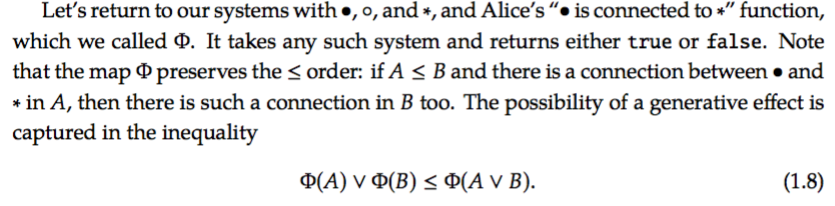
It's quite a neat idea to show how we can discover or generate an emergence effect by joining systems.


from Fong & Spivak, Seven Sketches in Compositionality.
timelets: (Default)
“...Japan, Korea, Taiwan and China perfected ways to marry subsidies and protection for manufacturers – so as to nurture their development – with competition and ‘export discipline’, which forced them to sell their products internationally and thereby become globally competitive. This overcame the traditional problem with subsidy and protection policies, whereby entrepreneurs pocketed financial incentives but failed to do the hard work of producing competitive products. Firms were not able to hide behind tariff and other barriers and sell only to a protected domestic market because protection, subsidies and credit were conditioned on export growth. Firms that did not meet the export benchmark were cut off from state largesse, forced to merge with more successful companies, or occasionally even bankrupted.”

Joe Studwell. “How Asia Works.”


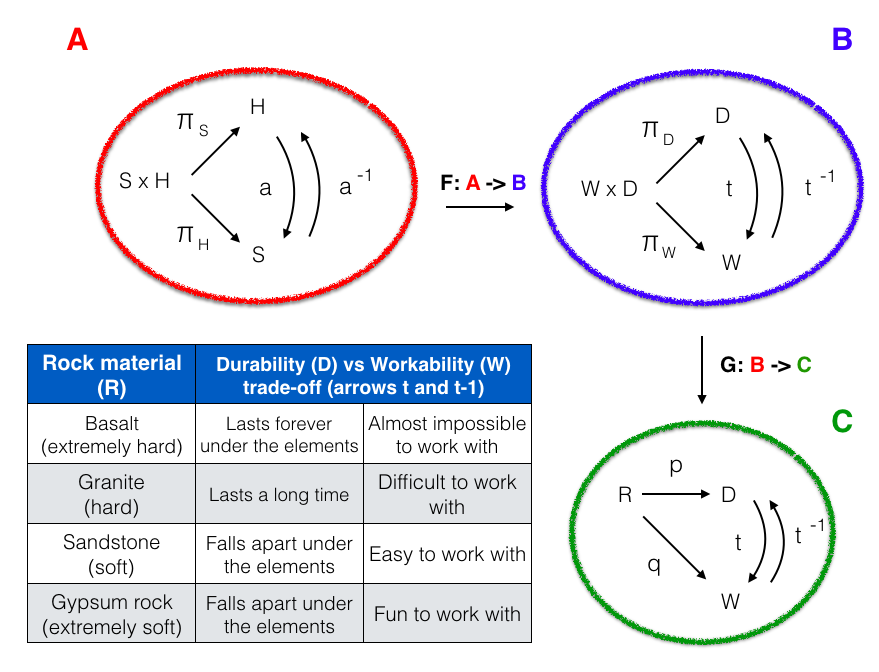
- On the one hand, you want to subsidize(finance) and protect promising unprofitable companies, so that they overcome the initial biz/tech handicap;
- On the other hand, you don't want to subsidize and protect unprofitable companies, so that they grow inefficient and require either direct or indirect subsidies/tariffs.

This dilemma is inherent in startups as well, and it's addressed through a similar (isomorphic!) VC solution. It also helps understand what enabled Amazon to solve the Innovator's Dilemma.

BTW, it shows that Russian industrial policy is doomed because of sanctions imposed on the country due to Putin's stupid foreign policy.
timelets: (Default)


upd. A more recent example would be the 19th century network of grain elevators in the Chicago area.

Made my day

Feb. 9th, 2018 08:55 pm
timelets: (Default)


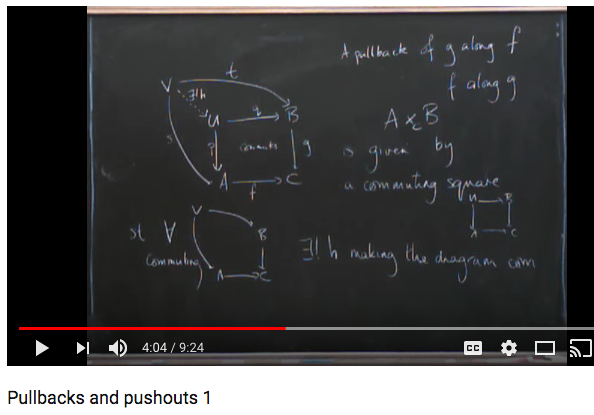
https://youtu.be/XGysPJvCXOc

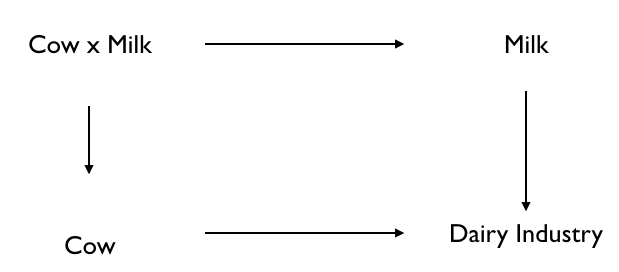
For some reason, understanding adjoints helped me better understand products, coproducts, pullbacks and pushouts. Maybe it's because of a specific application that I can play with to test various concepts against a version of relevant reality.

upd. also see https://youtu.be/BqRkULEhG40?t=6m15s

Profile

timelets: (Default)
timelets

December 2025

S M T W T F S
  12 3456
78910111213
14 151617 18 19 20
21 222324252627
28293031   

Syndicate

RSS Atom

Most Popular Tags

Style Credit

Expand Cut Tags

No cut tags
Page generated Dec. 24th, 2025 09:29 am
Powered by Dreamwidth Studios