timelets: (Default)


AI/ML divides reality differently than humans, i.e. it plays language games by completely different rules and fragmentation/synthesis levels.
timelets: (Default)
the yellow fever will discourage the growth of great cities in our nation; & I view great cities as pestilential to the morals, the health and the liberties of man. true, they nourish some of the elegant arts; but the useful ones can thrive elsewhere, and less perfection in the others with more health virtue & freedom would be my choice.

--- From Thomas Jefferson to Benjamin Rush, 23 September 1800.
https://founders.archives.gov/documents/Jefferson/01-32-02-0102


re: https://en.wikipedia.org/wiki/1793_Philadelphia_yellow_fever_epidemic

As usual, the future looks crazy, the past [even when represented by major figures of that time] looks stupid.
timelets: (Default)
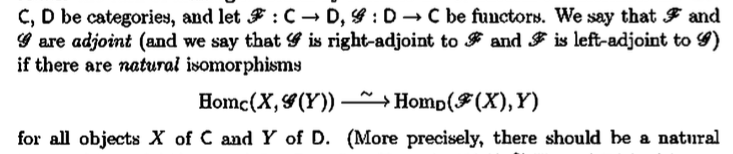
There's definitely a case for Crazy being a right adjoint to Stupid (left adjoint). For example, in the Three Little Pigs story the Wolf is a right adjoint, while the construction mess before that is the left adjoint.
Something like that:

Wolf: Pig x Pig -> Pig

Good Old Days: Pig -> Pix x Pig ( diagonal functor).

Similarly, Prince is a right adjoint to Cinderella.
timelets: (Default)
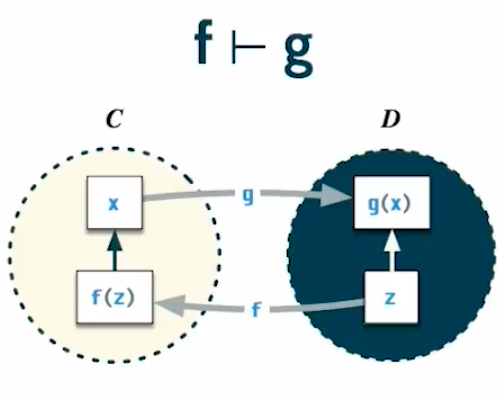
Crazy ⊣ Stupid
timelets: (Default)


In a two-level past-future transition, we get two different transition functions f (what is going to be there) and g (what is not going to be there). We also get two triples of adjoint functors, depending on how we construct a fibered domain of the past (product vs coproduct).

Lower-level past and future are modeled as exponential objects.

Setpast -> Setfuture
timelets: (Default)
Our deepest insights must—and should—appear as follies, and under certain circumstances as crimes, when they come unauthorizedly to the ears of those who are not disposed and predestined for them.

--- Friedrich Nietzsche, Beyond Good and Evil.


I've been thinking how to express formally the idea that the future as Crazy and the past as Stupid form adjoint functors. This is another instance of the same thought that circumstances make deep insights appear as fillies, i.e. crazy.
timelets: (Default)
“But the relation of language to painting is an infinite relation. It is not that words are imperfect, or that, when confronted by the visible, they prove insuperably inadequate. Neither can be reduced to the other's terms: it is in vain that we say what we see; what we see never resides in what we say. And it is in vain that we attempt to show, by the use of images, metaphors, or similes, what we are saying; the space where they achieve their splendour is not that deployed by our eyes but that defined by the sequential elements of syntax.
...
But if one wishes to keep the relation of language to vision open, if one wishes to treat their incompatibility as a starting-point for speech instead of as an obstacle to be avoided, so as to stay as close as possible to both, then one must erase those proper names and preserve the infinity of the task. It is perhaps through the medium of this grey, anonymous language, always over-meticulous and repetitive because too broad, that the painting may, little by little, release its illuminations.”

Foucault, Michel. “The Order of Things: An Archaeology of Human Sciences.”

He makes an excellent point about a fundamental incompatibility between two systems of representation as a beginning, rather than a dead-end obstacle.

Made my day

Feb. 9th, 2018 08:55 pm
timelets: (Default)


https://youtu.be/XGysPJvCXOc

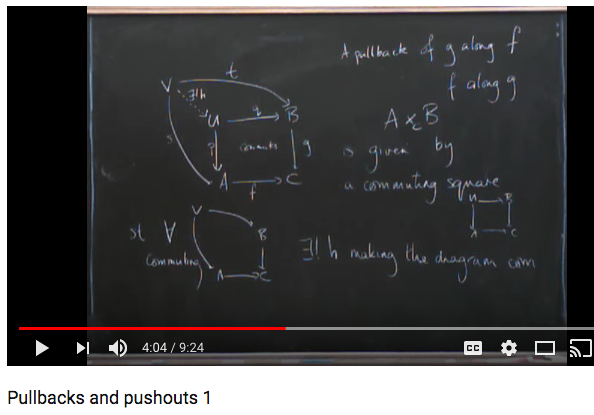
For some reason, understanding adjoints helped me better understand products, coproducts, pullbacks and pushouts. Maybe it's because of a specific application that I can play with to test various concepts against a version of relevant reality.

upd. also see https://youtu.be/BqRkULEhG40?t=6m15s
timelets: (Default)
I think I'm starting to understand adjoints.


Somewhat related https://youtu.be/USYRDDZ9yEc
timelets: (Default)
Оттуда же:
Создавая формальный язык описания, схематизируя реальность, производя идеацию, наука создаёт область контринтуитивного и непонятного. Сколько выигрывается для экономии познания на формализации и кратком чётком обозначении идеализованных однородных элементов, столько теряется в понятности и требует времени для интерпретации, популярного изложения и обучения. Наука создаёт область ясного знания, и чем оно яснее, тем более удалено от обычного взгляда и здравого смысла.

Любарский, Г.Ю. 2011.


When we have two formal systems that are difficult to understand due to their idealization schemes the right functor can serve as an explanation. In this approach, adjoints would form complementary explanations.
timelets: (Default)
Here's a good illustration of how old guns map to new ones. For the right model we should represent it as a functor between two worlds, e.g. to take into account the increase in population density, which makes automatic weapons even deadlier. I have a feeling it would be a good case for an adjoint.


upd: mass-produced automatic weapons created a military technology revolution that resulted in millions of death in WWI.
timelets: (Default)
Before I forget, several thoughts that seem to converge:
- the idea of reusability that came up in comments from lxe;
- the assumption of intelligibility of the world from Mind and Cosmos, by Thomas Nagel;
- the topos structure of decision-making and truth tables from Category Theory;
- a possible adjoint between "what is" and "what ought to be" from CT and Herbert Simon;
- the network effect of property rights.
timelets: (Default)
Here's two categories: Technology and Business

Technology is represented by a product of desires DxD. Desires conflict; therefore, one desire D is a PreOrder, while another is a PreoOrder Op. That is, improving our position on one desire makes another one worse off. Each desire has a terminal object 1, which is the lowest performance threshold, respectively. The thresholds form technical specification 2.

Business is represented by a Utility Monoid, e.g. a combination of Revenues (or expenses). Business has a terminal object 1, which represents profitability requirements, i.e. "the bottom line." The business would like to increase Utility, but it is constrained by the conflict of desires in Technology.

We can probably build adjoints, but I don't know how to specify them.

timelets: (Default)
Empirical data shows that new technologies succeed in combination with new markets only. I have a gut feeling that we can prove it theoretically using adjoint functors.
timelets: (Default)
It seems like effect (F) and understanding (U) are adjoint functors.

upd.

Learning/Sci -> Technology -> Business

Business -> Technology -> Learning/Sci

Profile

timelets: (Default)
timelets

December 2025

S M T W T F S
  12 3456
78910111213
14 151617 18 19 20
21 222324252627
28293031   

Syndicate

RSS Atom

Most Popular Tags

Style Credit

Expand Cut Tags

No cut tags
Page generated Dec. 25th, 2025 09:01 am
Powered by Dreamwidth Studios