The Green Revolution
May. 2nd, 2018 11:54 am![[personal profile]](https://www.dreamwidth.org/img/silk/identity/user.png) timelets
timeletsBecause pure line (genotypically identical) plant varieties often only have one or a few major genes for disease resistance, and plant diseases such as rust are continuously producing new races that can overcome a pure line's resistance, multiline varieties were developed. Multiline varieties are mixtures of several phenotypically similar pure lines which each have different genes for disease resistance. By having similar heights, flowering and maturity dates, seed colors, and agronomic characteristics, they remain compatible with each other, and do not reduce yields when grown together on the field.
...
Between five and ten of these lines may then be mixed depending upon the races of pathogen present in the region. As this process is repeated, some lines will become susceptible to the pathogen. These lines can easily be replaced with new resistant lines. As new sources of resistance become available, new lines are developed. In this way, the loss of crops is kept to a minimum, because only one or a few lines become susceptible to a pathogen within a given season, and all other crops are unaffected by the disease. Because the disease would spread more slowly than if the entire population were susceptible, this also reduces the damage to susceptible lines.
https://en.wikipedia.org/wiki/Norman_Borlaug
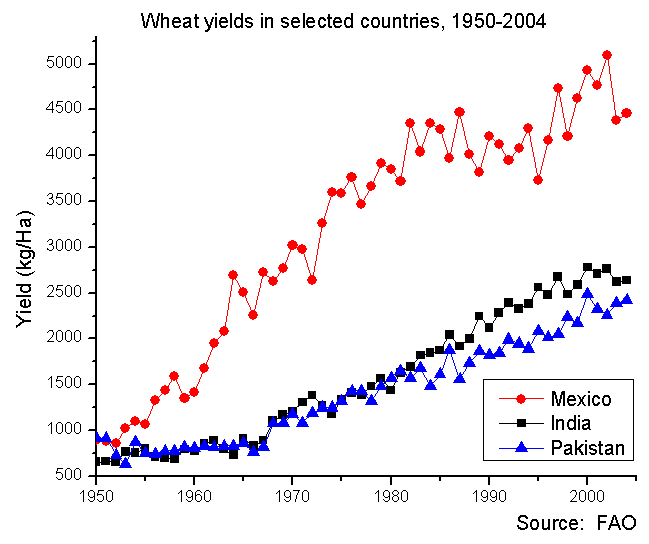
This is an interesting dilemma: On the one hand, you want to have pure lines because they enable scalable agricultural techniques. On the other hand, you don't want to have pure lines because they are susceptible to the same disease. In short, sameness/uniformity enables scalability, both for humans and pathogens. We can also point out directly opposing desires for : D1 - pure line; D2 - multiline.
Dwarfing was another conceptual breakthrough:
Taller wheat grasses better compete for sunlight, but tend to collapse under the weight of the extra grain—a trait called lodging—from the rapid growth spurts induced by nitrogen fertilizer.
To prevent this, he bred wheat to favor shorter, stronger stalks that could better support larger seed heads.


