![[personal profile]](https://www.dreamwidth.org/img/silk/identity/user.png)
Aug. 12th, 2018


Speaking of Omarosa
Aug. 12th, 2018 11:58 amEnvironmental Influences on Cognitive and Brain Plasticity During Aging. Kramer, et. al. 2004.
https://academic.oup.com/biomedgerontology/article/59/9/M940/535383
https://doi.org/10.1093/gerona/59.9.M940
among other things:
https://academic.oup.com/biomedgerontology/article/59/9/M940/535383
https://doi.org/10.1093/gerona/59.9.M940
among other things:
Similarly, studies reporting change in memory measures and crystallized intelligence suggest that education has a protective effect. For instance, results from the MacArthur Studies of Successful Aging showed that low levels of education (apart from cognitive performance at baseline) was the strongest predictor of cognitive decline in measures of verbal and nonverbal memory, conceptualization, and nonverbal abilities over 2–2.5 years in a sample of 70–79 seniors (46). However, education seems to be a less powerful predictor of changes in fluid abilities and processing speed.
...
The main finding of this research was that the level of complexity of an occupation positively influences the level of intellectual functioning for both men and women. Furthermore, this relationship between occupational complexity and intellectual function increases with age. Similar effects have been reported in other studies of the relationship between occupational complexity and intellectual functioning in the United States, Poland, Japan, and the Ukraine (64–70). Schooler and Mulatu (71) reported additional evidence of a relationship between cognitively complex activities and cognitive functioning when leisure time activities are considered. Cognitively stimulating leisure activities were defined as activities such as the number of books and magazines read, numbers of hobbies and other interests, and so forth.
(no subject)
Aug. 12th, 2018 12:32 pm
Rationally, people should want to receive information that is costless and relevant for a decision. But people sometimes choose to remain ignorant. The current paper identifies intuitive-deliberative conflict as a driver of information avoidance.
....
We contend that people avoid information when two conditions are satisfied: (1) they want to protect their current preference and (2) they recognize that their preference may change with information. Situations that involve an intuitive-deliberative conflict are likely to lead to information avoidance because when people have conflicting preferences, they may not trust that their current preference will win out in the face of new information.
Woolley, K., & Risen, J. L. (2018). Closing your eyes to follow your heart: Avoiding information to protect a strong intuitive preference. Journal of Personality and Social Psychology, 114(2), 230-245. http://dx.doi.org/10.1037/pspa0000100
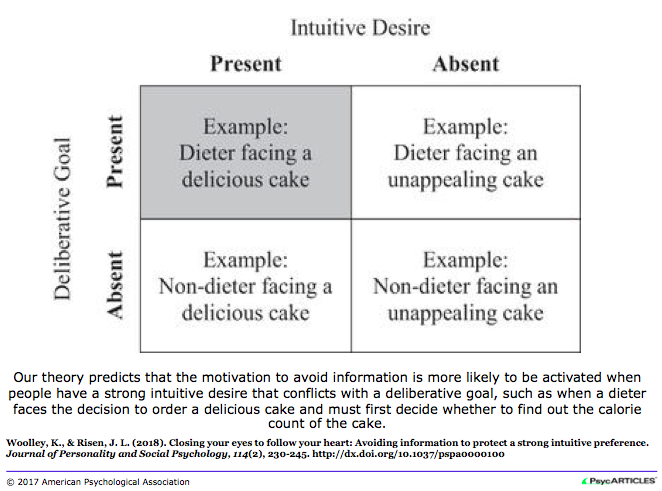
This is an interesting application of Kahneman's System1/2 theory to decision making. We can think of it as an "internal" information asymmetry between intuitive and deliberate self.
TIL: income flow
Aug. 12th, 2018 03:14 pmAccording to the Congressional Budget Office, virtually all of the growth in pre-tax household income over the QE period (2009 to 2014) occurred in the upper decile of the US income distribution, where the Fed’s own Survey of Consumer Finances indicates that the bulk of equity holdings are concentrated.
On a somewhat related note: after reading This Time It's Different, I have a feeling that financial troubles abroad typically lead to asset bubbles in the US. My guess would be that this time around residential real estate would not be it.
https://fred.stlouisfed.org/graph/?g=kQrC
https://fred.stlouisfed.org/graph/?g=kQse