![[personal profile]](https://www.dreamwidth.org/img/silk/identity/user.png)


Entry tags:
The art of dividing people
This is a follow-up to the tricky questions discussion.
The recipe seems to be to construct a no-brainer question that prompts an intuitive System 1 "yes" response. For example, Do you prefer $1 to $1,000,000? or Why do we need people from shithole countries? or Do we need to deport illegal immigrants? etc. The question can be easily mapped to object 2 {0,1}.
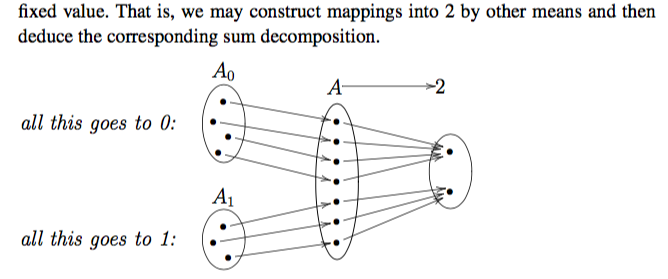
The tricky part comes from constructing a question so that it it maps to a 2x2 object (rather than 2) with skewed values: A = {0,1}; B = {1,0} -- note that objects {0,0} and {1,1,} are missing. Therefore, by choosing A or B we are always "right" in one dimension and "wrong" in another dimension. Understanding this portion requires System 2 thinking.
Example 1. Do you prefer state {$1, $2} to state {$1, $1,000,000}? The no-brainer System 1 dimension is, e.g. the total welfare of the state or Pareto improvement from a transition from the first to the second state. The System 2 (slow thinking) dimension is extreme inequality. The object is constructed so that a preference for welfare requires a preference for extreme inequality {0,1} or vice versa: a preference for socially acceptable inequality requires a preference for poverty {1,0}.
Example 2, Do we need more people from shithole countries or those from Norway? The no-brainer System 1 dimension is quality of the country, which is obviously bad vs good, i.e {0,1} The System 2 dimension is the quality of an individual from that country, which American history shows is often {1,0}. Being "right" in the first dimension reveals System 1 bias.
Example 3, Should we deport illegal immigrants?
As a communication medium, Twitter conditions the public to fast "no-brainer" System 1 responses.
I need to show this formally with proper arrows and objects.
The recipe seems to be to construct a no-brainer question that prompts an intuitive System 1 "yes" response. For example, Do you prefer $1 to $1,000,000? or Why do we need people from shithole countries? or Do we need to deport illegal immigrants? etc. The question can be easily mapped to object 2 {0,1}.
The tricky part comes from constructing a question so that it it maps to a 2x2 object (rather than 2) with skewed values: A = {0,1}; B = {1,0} -- note that objects {0,0} and {1,1,} are missing. Therefore, by choosing A or B we are always "right" in one dimension and "wrong" in another dimension. Understanding this portion requires System 2 thinking.
Example 1. Do you prefer state {$1, $2} to state {$1, $1,000,000}? The no-brainer System 1 dimension is, e.g. the total welfare of the state or Pareto improvement from a transition from the first to the second state. The System 2 (slow thinking) dimension is extreme inequality. The object is constructed so that a preference for welfare requires a preference for extreme inequality {0,1} or vice versa: a preference for socially acceptable inequality requires a preference for poverty {1,0}.
Example 2, Do we need more people from shithole countries or those from Norway? The no-brainer System 1 dimension is quality of the country, which is obviously bad vs good, i.e {0,1} The System 2 dimension is the quality of an individual from that country, which American history shows is often {1,0}. Being "right" in the first dimension reveals System 1 bias.
Example 3, Should we deport illegal immigrants?
As a communication medium, Twitter conditions the public to fast "no-brainer" System 1 responses.
I need to show this formally with proper arrows and objects.